
The Alternatives Series · Part 1 of 5
Alternative Investments: A Plain-English Primer
What they are, what they cost, and who actually needs them
Alan F. Skrainka, CFA
Chief Investment Officer
Walk into almost any wealth-management conversation today and the subject of alternatives will come up. Private equity, private credit, hedge funds, real estate, infrastructure — once the preserve of pensions and the very wealthy, these products are now being packaged for ordinary investors and sold with real enthusiasm. Before you decide whether they belong in your portfolio, it helps to understand plainly what they are, what they cost, and what they can and cannot do. That is the job of this first piece. The harder questions — whether they actually deliver — come later in the series.
What counts as an “alternative”
An alternative investment is, simply, anything outside the traditional world of publicly traded stocks and bonds. The category is broad, and part of its appeal is that these assets often move a little differently from the public market, which is why they get sold as diversifiers. The usual members of the family:
- Private equity: ownership stakes in private companies, including leveraged buyouts.
- Private credit: direct lending to companies, outside the banking system — the fastest-growing corner.
- Hedge funds: pooled vehicles using short selling, leverage, and derivatives to pursue returns.
- Real estate (private): pooled interests in property whose shares don’t trade on an exchange — non-traded REITs, private real estate funds, and direct ownership. Publicly traded REITs, by contrast, trade like ordinary stocks and sit in the S&P 500, so they aren’t really alternatives.
- Venture capital: funding for early-stage, high-growth start-ups.
- Infrastructure: long-lived projects such as roads, energy grids, and utilities.
- Commodities and collectibles: gold, oil, farmland; and tangibles like art, wine, and vintage cars.
Liquid versus illiquid — the distinction that matters most
Not all alternatives lock up your money, and the difference is the single most important thing to understand before investing. Liquid alternatives trade on public markets and can be bought and sold with relative ease — commodity ETFs, managed futures, and liquid hedge-fund strategies. Illiquid alternatives ask for a long-term commitment with limited ways out: private equity, venture capital, direct real estate, and hedge funds with lock-up periods. Historically these were reserved for institutions and high-net-worth investors who could afford to wait. The new wave of “semi-liquid” funds promises a middle ground — private assets with periodic redemption windows — but as Part 2 of this series shows, that promised liquidity has a way of disappearing exactly when investors want it.
The marketing leads with returns and diversification. The features you can actually verify in advance are the fees, the lockup, and the once-a-quarter pricing.
The pitch: three promises
Alternatives are sold on three promises: higher returns than public stocks and bonds; a smoother ride, with smaller swings along the way; and diversification, the idea that these assets steady a portfolio because they move differently from public markets. Each promise sounds reasonable. Each is also harder to verify than it looks, largely because private funds are not priced every day — the manager estimates their value, usually once a quarter. Whether the promises hold up under careful measurement is the subject of Part 2. For now, treat them as claims to be tested, not facts.
What the history suggests — and why to read it skeptically
Long-run return figures for alternatives look attractive on the page. The table below summarizes commonly cited historical ranges.
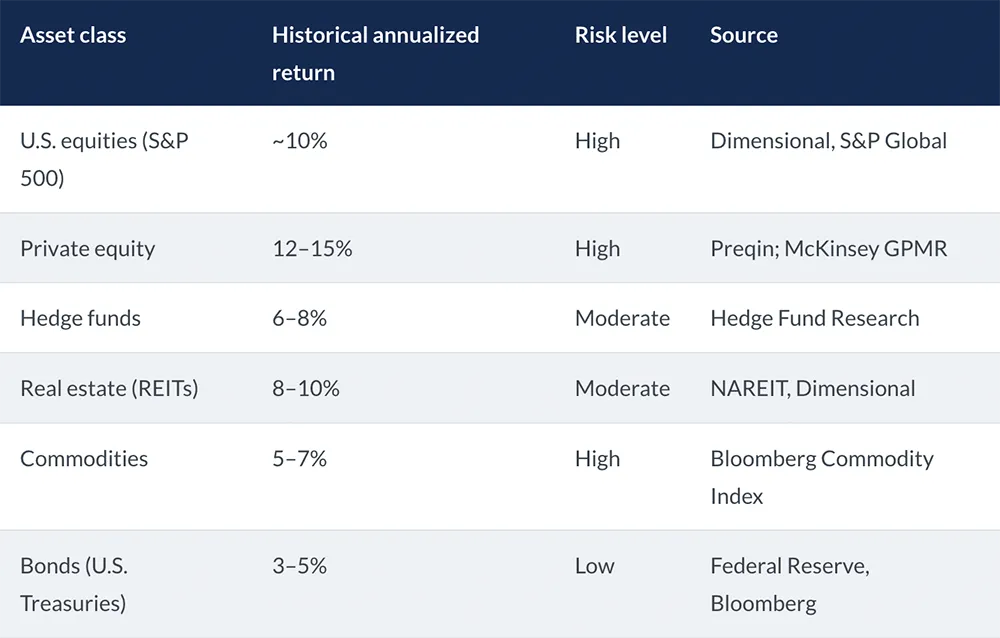
Illustrative historical ranges compiled from the sources noted; figures vary by period and methodology and are not directly comparable across asset classes.
Read those numbers with care, because several forces flatter them. Survivorship bias: weak funds quietly close, so the surviving averages look better than the full experience investors actually had. Smoothed pricing: because values are estimated occasionally rather than marked daily, reported volatility looks lower than the underlying reality. And the averages hide enormous dispersion — the gap between the best and worst private funds is vast, and unlike a public index, you cannot simply buy the whole market. You are forced to bet on a specific manager, which Part 4 takes up directly.
The costs are the part you can verify
If the returns are uncertain, the costs are not. Alternative funds typically charge far more than index funds — a management fee plus a performance cut, the classic arrangement being “2 and 20”: two percent of assets a year plus twenty percent of the gains. Layer on illiquidity, opacity, and complexity, and the burden of proof sits squarely on the product to justify itself. The main risks, in plain terms:
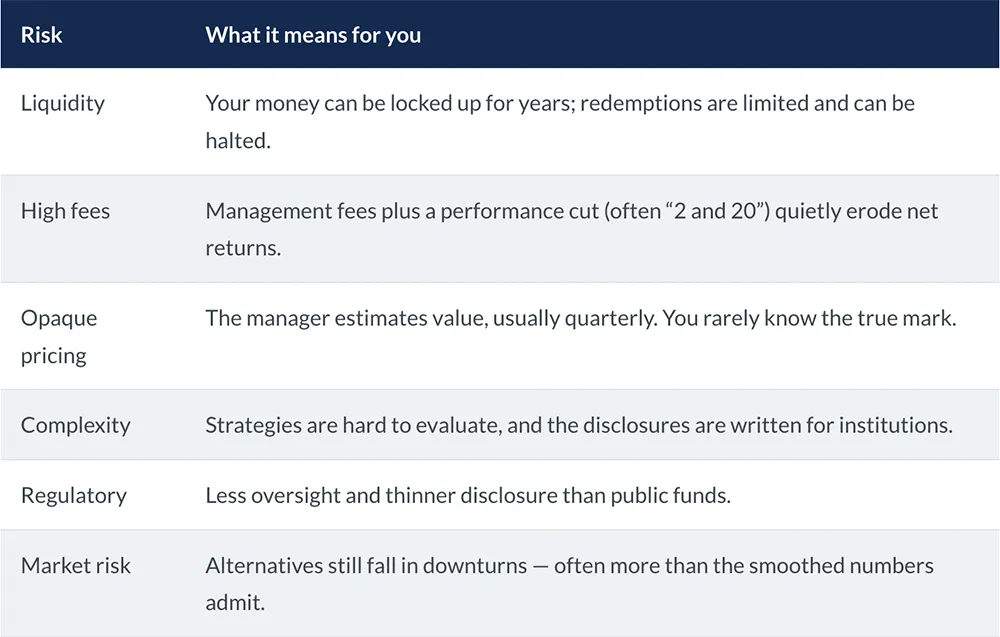
One item on that list deserves more than a single row, because it quietly enables several of the others: light regulation. Many alternatives, hedge funds and private funds especially, are not registered with the SEC the way a public mutual fund is, and they disclose far less. Reporting performance to the databases that build industry benchmarks is frequently voluntary, valuations are often set by the manager rather than by a daily market, and the audited, standardized disclosure you take for granted in public markets is thinner or absent. None of this makes a fund a fraud. It does mean the burden of verification falls on you, and that the track record you are shown may be the flattering part of a longer story — a problem Part 3 takes up in detail.
How much, if any?
Conventional advice suggests that high-net-worth investors might hold something like 10 to 20 percent of a portfolio in alternatives, usually carved out of the stock allocation in pursuit of higher returns, or occasionally out of bonds via lower-risk options like infrastructure. But “can hold” is not “must hold.” The more useful question is whether you need them at all.
Are alternatives necessary? For most investors, no
Alternatives are routinely described as essential for diversification. They are not. A well-built, low-cost portfolio of public stocks and bonds remains a sound long-term strategy, and most investors — including many affluent ones — can reach their goals without ever tying up money for a decade or paying a performance fee. Alternatives may have a place for those who genuinely understand the trade-offs, can tolerate illiquidity, and have the capital to diversify across several managers and vintages. For everyone else, they are an option to weigh carefully, not a box that must be checked. The burden is on the product to prove it earns its keep — and the rest of this series puts that claim to the test.
Next, in Part 2: when you measure private-market returns honestly, against the right public yardsticks and after fees, how much of the celebrated premium is actually left?
Important Disclosures
This material is provided for educational purposes only and reflects general guidance, not personalized investment advice. Alan Skrainka, LLC is not a registered investment adviser, and nothing herein should be construed as a recommendation to buy, sell, or hold any security or to pursue any particular investment strategy. Alternative investments involve significant risks, including illiquidity and the potential loss of capital, and are not suitable for all investors. Past performance is not indicative of future results. Readers should consult a qualified financial professional regarding their individual circumstances before making any investment decision.
The Alternatives Series · Read in order
- Do the Best Managers Stay the Best?
- Are Private Markets Worth It?